Beginning
Transliteration is the process of converting text from one writing system or alphabet into another while maintaining the sound of the original words. Unlike translation, which converts meaning, transliteration converts the letters or characters themselves based on their phonetic pronunciation. It represents how something sounds in its original language using a different alphabet or writing system, rather than what it means.
trans- From Latin trans, meaning "across," "beyond," or "through." It indicates movement from one side to another, or passage through/across something. The prefix trans can indicate literal spatial movement across something, passage through a medium, change from one state to another, or movement beyond boundaries.
literation- From Latin littera meaning "letter" - as in a character of an alphabet, a written document or epistle, handwriting, learning/scholarship. It can also mean the exact wording of something.
Transliteration is language in migration. It is sensorially ambulatory, loosened from its recent (keeping in mind that language does not evolve within chaste structural linearities) semantic past. This module is in no way an attempt at a comprehensive look at all the ways transliteration functions in language or art. It is another way to draw on the senses, to play with the what we mean by meaning, to question modalities of representation and abstraction and let materials make up their own languages. Transliteration is an expression of the para-representational. It sidles interpretive meaning through sensorial movement. The para is alongside and in excess of. If representation is the organization of sensory information into narrative forms that correspond to collective ideas about how the world is, and abstraction is sensation without the storying of forms, the para-representational is the bleeding of one into the other, a bothness of recognition and disorientation. It is less the sense of something and more a sensitizing to what can be felt but not named.
For this module, I invite us all to bring our experiences, texts, ideas, word games, artistic inspirations, and experiments into this container for co-inquiry. We will be working with materials that we all collectively source, mixing them up. To begin populating this field of experimentation, please add your materials to this folder.
Materials
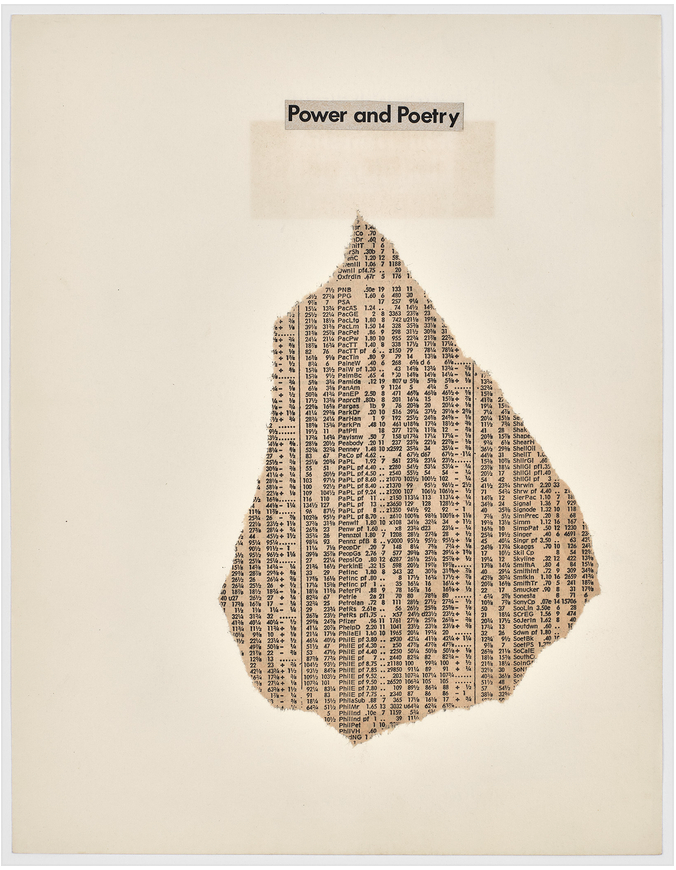
N.H. Pritchard, Untitled (Power and Poetry), no date, printed paper collage 11” x 8 1/2”
We will be playing with the ways we come into material relation with language, how language can be a sensorial presence, a non-cognitive intimacy. Our aim is not to define but to play, via material exploration, in the spaces between, in the minor gesture, in the hand and body movements, the mouth, throat and tongue sensations of the untranslatable (and for how long? when does un become a new form of translation?) that shapes our affective relations with meaning and expression. Material exploration will therefore be our
Guides
In each module, we seek out guides, muses, monsters and unreliable narrators to accompany us on our journey. We start with a few friends and flirtations, and pick up others along the way. For TRANSLITERATION, we will begin with:
N.H. Pritchard and here
PART ONE: TRANSADDITIONS/TRANSDELETIONS
Session One: Write Your Name